
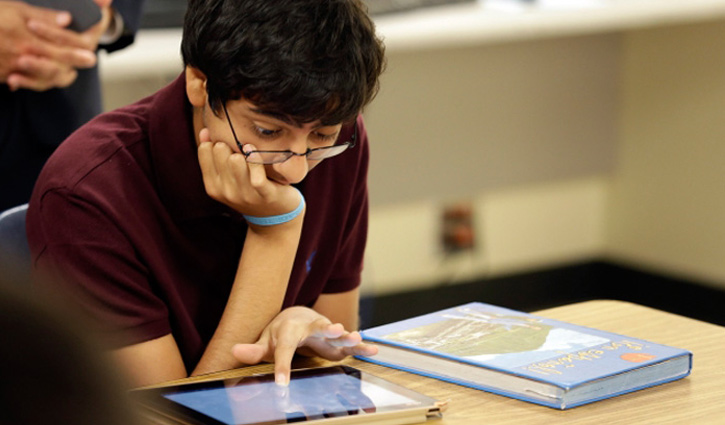
The literature that should nourish the tender minds of today’s children now lies far beyond their reach. Instead of books, young children sit absorbed in mobile phones or tablets—products of advanced technology bestowed by modern science.
The rhymes of childhood—“Ata Gacher Tota Pakhi” or “Ay Ay Chand Mama”—have been replaced by video games and cartoons. Of course, these devices can offer rich digital education and age-appropriate literary content if one seeks it. Yet, leaving literature aside, children spend most of their time immersed in games.
Children between the ages of five and seven are known in children’s literature as “young readers.” But they, too, are spending their days in much the same way. These young readers begin school at six or seven, yet after returning home, they remain mostly busy with mobile phones or tablets, forgetting outdoor play altogether. Ironically, with a little encouragement, they could easily read beautifully designed e-books written by children’s authors through various e-book applications.
The situation of older children is equally alarming, perhaps even more so. Their minds bear no trace of the core elements of children’s literature: education, joy, and imagination. At this very age, they should be immersed in harvesting the sweetness of literature, gradually developing an interest in writing rhymes and stories themselves.
Today, many children and adolescents are heard saying, “I don’t like poetry” or “I don’t enjoy stories.” Is this not the inevitable result? From a very early age, as they grow older, children are absorbing harm from the excessive conveniences of technology. Instead of addiction to video games on phones, they could be reading countless valuable free e-books available online. Moreover, keeping pace with modernity, they could be encouraged to engage with various digital institutions in the country that provide e-book services. Yet, none of this is visibly happening.
In this regard, alongside the diminishing emphasis on reading habits in schools, parental negligence must also be acknowledged as a major contributing factor. I believe this will bring highly undesirable consequences for the future. If parents wished, children could easily take even a brief journey into the world of digital literature. Instead, we see them becoming engrossed in video games after school.
Furthermore, children must be given opportunities—at least an hour a day—for outdoor play in suitable spaces, replacing excessive video gaming with children’s literature and physical activity. They should be encouraged to spend time with friends. This will grant children a colorful, vibrant childhood—one that prepares an intellectually enriched future.
Current Source: Reporting a Changing World by Parvej Husen Talukder (Native work language: Bengali, Source: RisingBD)